As the PV system voltage advances into the 1500V and even 2000V era, the focus of industry competition is shifting back from a pure "power race" to the essence of "system safety" and "Levelized Cost of Electricity (LCOE)." At the 2026 SNEC International Photovoltaic Power Generation and Smart Energy Conference, the R&D Manager of Zhejiang Chint Xinhui Photovoltaic Co., Ltd. took the stage to deliver a keynote speech, directly addressing industry pain points and providing an in-depth analysis of "Risk Points and Solutions for PV Connection Systems."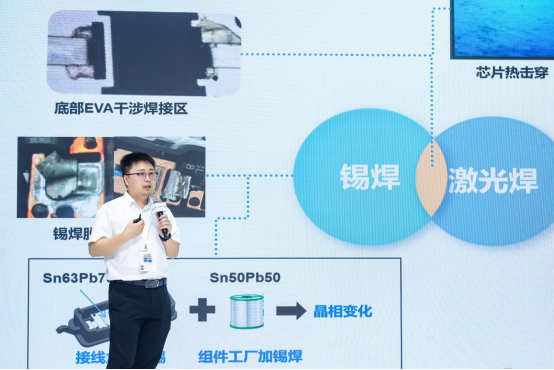
In the LCOE accounting of PV power plants, module conversion efficiency and inverter conversion efficiency are often regarded as the core drivers for cost reduction and efficiency enhancement. However, the PV connection system—serving as the current transmission carrier and encompassing junction boxes, connectors, and harnesses—is frequently overlooked due to its minimal cost proportion. According to statistics from the EU "Solar Bankability" project, annual losses caused by connector damage and improper cable usage reach as high as 2.67 €/kWp and 3.93 €/kWp, respectively. System failure losses associated with junction boxes and connectors have already exceeded the sum of module PID effects and inverter failures, becoming the primary loophole for power plant asset erosion. Based on Failure Mode and Effects Analysis, Chint Xinhui proposed a one-stop technical solution targeting industry pain points.
I. Junction Boxes: Reconstruction of Thermal Management and Testing Standards
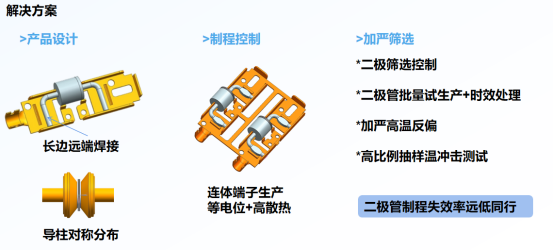
As the critical node for component electrical output, the core risk of the junction box concentrates on diode thermal runaway.
Failure Mechanism: Driven by "extreme cost reduction," the industry commonly adopts strategies of reducing chip sizes (e.g., replacing 150T with 130T), leading to decreased thermal capacity. Simultaneously, if thermal stress during the manufacturing process is not effectively released, it results in diode fatigue fracture during operation.
Standard Deviation: Current industry junction temperature testing suffers from severe data distortion. Lab data from Chint Xinhui indicates that merely varying the voltage sampling wire diameter (0.2mm² compared to 4mm²) can result in a 75℃ difference in junction temperature readings. Furthermore, variations in sample layer distribution within the constant temperature chamber and lead clamping positions lead to non-repeatable test results, failing to reflect true product thermal performance.
Chint Xinhui Solution: We insist on adopting 190mil/210mil large-specification chips and introducing axial R8 packaging technology. On the testing front, we have reconstructed the testing protocol: standardizing sample preparation conditions, abandoning the cabinet digital display temperature, and using the measured temperature around the box body as the calculation benchmark, ensuring the diode process defect rate is far lower than the industry average.
II. Connectors: Breakthroughs in Material Weathering Resistance and Chemical Compatibility
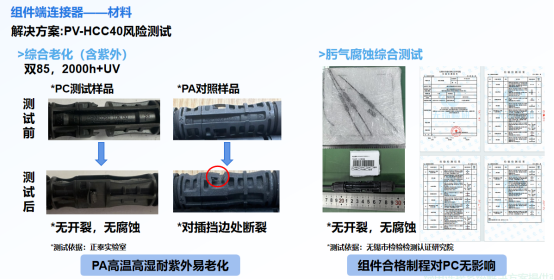
Connector failures are largely attributed to stress cracking and chemical corrosion of polymer materials.
Material Risks: Mainstream materials currently exhibit distinct shortcomings: PPE material has poor chemical resistance and is prone to stress cracking; PC material carries the risk of oxime gas reaction; PA material, despite excellent performance, suffers from severe moisture absorption and high costs. Residual flux, board cleaners, oil stains, and even cooking oil on construction sites can induce brittle fracture in PPE materials in the short term.
Chint Xinhui Solution: Launch of the industry's first PV-HCC40 composite structure connector. This product utilizes the high plasticity of PC to optimize the positive electrode creepage distance and nests the negative electrode using PA with a high CTI (Comparative Tracking Index) value. This design meets 1500V system voltage requirements while completely eliminating the risk of water-absorption stress cracking. Corrosion resistance tests confirm that its structural integrity is significantly superior to traditional PPE materials when exposed to strong corrosive chemicals such as board cleaners and adhesive removers.
III. Harness Systems: Innovative Copper-Aluminum Connection Technology, Ensuring Reliability, Safety, and Economy
With module power exceeding 700W+, traditional 4mm² copper cables are approaching their current-carrying limits, and fluctuating copper prices are intensifying BOS cost pressure for power plants.
Technical Bottleneck: While aluminum wiring offers advantages in lightweight and low cost, copper-aluminum electrochemical corrosion and surging contact resistance are the root causes of melting accidents.
Chint Xinhui Solution: The PV-HCB50 series copper-aluminum connector overcomes this technical barrier.
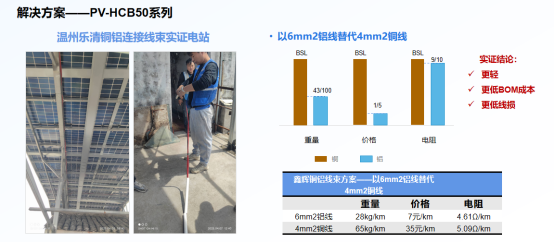
Process Innovation: Implementation of factory-level professional equipment crimping simplifies on-site construction to "plug-and-play," eliminating hidden dangers caused by non-standard field crimping.
Empirical Data: The Wenzhou Yueqing empirical power plant verified the feasibility of "replacing 4mm² copper wire with 6mm² aluminum wire," achieving significant cost reduction and weight saving while ensuring safe current carrying capacity.
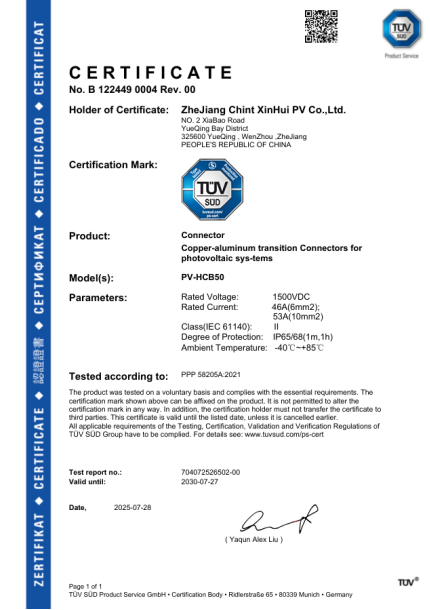
Establishing a High-Reliability Connection Paradigm to Secure Asset Value Across the Power Plant Lifecycle
As the core force within the Chint system deeply cultivating the PV electrical connection field, Chint Xinhui's roadshow presentation is not merely about 'Solar Bankability' statistics: "Annual losses from connector damage and improper cable use far exceed those from inverter failures. Although the connection system is small, it is the shortest plank determining the safety of power plant assets."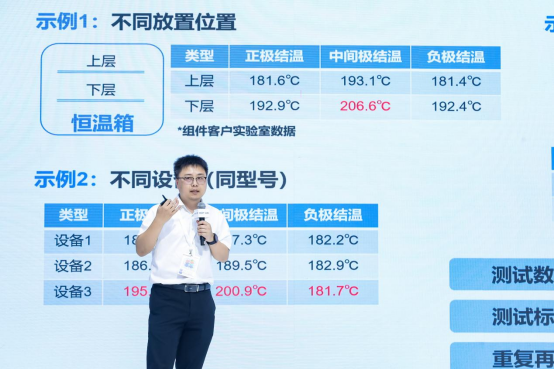
Chint Xinhui firmly believes that true cost reduction must never come at the expense of safety margins. Rather, it is achieved through breakthroughs in materials science, stringent manufacturing processes, and the reconstruction of testing standards to eliminate risks invisibly. We persist in using rigorous process control and innovative material technologies to achieve "quality improvement, cost reduction, and full coverage" for our customers. Chint Xinhui is willing to join hands with industry peers to reinforce the safety defense line of PV power plants.